http://en.wikipedia.org/wiki/GDP GDP per capita is often used as an indicator of standard of living in an economy. While this approach has advantages, many criticisms of GDP focus on its use as a sole indicator of standard of living.
The major advantages to using GDP per capita as an indicator of standard of living are that it is measured frequently, widely and consistently; frequently in that most countries provide information on GDP on a quarterly basis (which allows a user to spot trends more quickly), widely in that some measure of GDP is available for practically every country in the world (allowing crude comparisons between the standard of living in different countries), and consistently in that the technical definitions used within GDP are relatively consistent between countries, and so there can be confidence that the same thing is being measured in each country.
The major disadvantage of using GDP as an indicator of standard of living is that it is not, strictly speaking, a measure of standard of living. GDP is intended to be a measure of particular types of economic activity within a country. Nothing about the definition of GDP suggests that it is necessarily a measure of standard of living. For instance, in an extreme example, a country which exported 100 per cent of its production would still have a high GDP, but a very poor standard of living.
The argument in favour of using GDP is not that it is a good indicator of standard of living, but rather that (all other things being equal) standard of living tends to increase when GDP per capita increases. This makes GDP a proxy for standard of living, rather than a direct measure of it. GDP per capita can also be seen as a proxy of labor productivity. As the productivity of the workers increases, employers must compete for them by paying higher wages. Conversely, if productivity is low, then wages must be low or the businesses will not be able to make a profit.
There are a number of controversies about this use of GDP
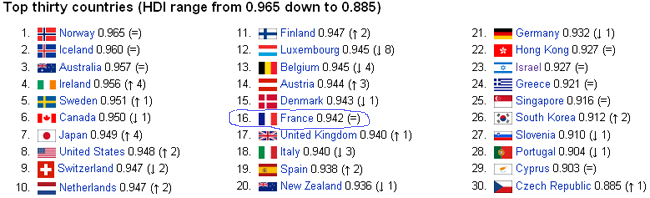
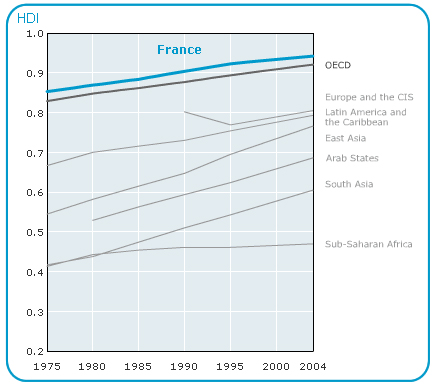
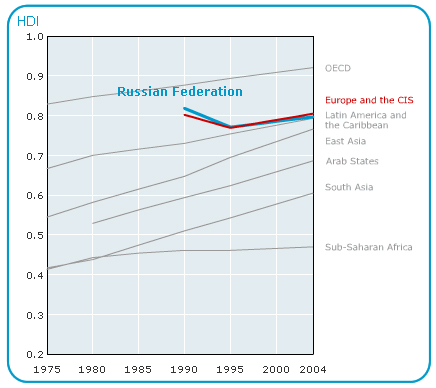
http://en.wikipedia.org/wiki/Human_Development_Index The Human Development Index (HDI) is a comparative measure of life expectancy, literacy, education, and standard of living for countries worldwide. It is a standard means of measuring well-being, especially child welfare. It is used to determine and indicate whether a country is a developed, developing, or underdeveloped country and also to measure the impact of economic policies on quality of life.[1] The index was developed in 1990 by Pakistani economist Mahbub ul Haq and has been used since 1993 by the United Nations Development Programme in its annual Human Development Report.
The HDI measures the average achievements in a country in three basic dimensions of human development:
* A long and healthy life, as measured by life expectancy at birth.
* Knowledge, as measured by the adult literacy rate (with two-thirds weight) and the combined primary, secondary, and tertiary gross enrollment ratio (with one-third weight).
* A decent standard of living, as measured by gross domestic product (GDP) per capita at purchasing power parity (PPP) in USD. _________________ A la guerre comme a la guerre èëè âòîðà ÿ ðåäà êöèÿ Çà áóãîðГîâГ
Вы не можете начинать темы Вы не можете отвечать на сообщения Вы не можете редактировать свои сообщения Вы не можете удалять свои сообщения Вы не можете голосовать в опросах


 FAQ
FAQ Поиск
Поиск Пользователи
 Группы
 Регистрация
 Профиль
 Войти и проверить личные сообщения
 Вход
Вход